The Great API Reset: How PSD3 is Forcing Banks to Think Like Tech Companies
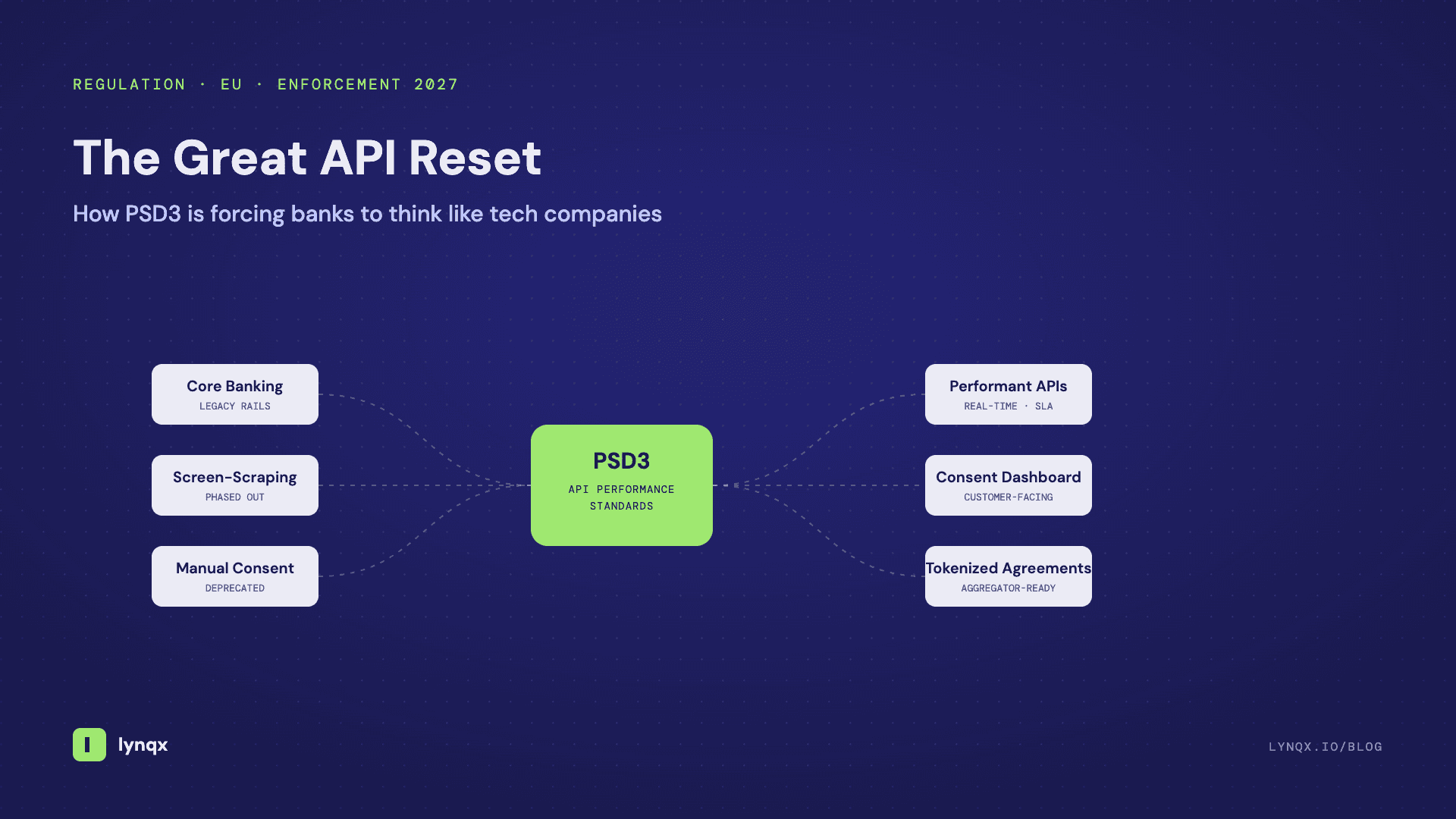
PSD3's enforcement lands in mid-to-late 2027, and banks that treat it as another compliance checkbox are about to learn an expensive lesson. This isn't incremental tightening of existing rules — it's a forcing function that rewards banks who rearchitect now and punishes the ones who wait for the deadline to get close.
The regulation's teeth are technical, not just legal: API performance standards with enforceable uptime and latency thresholds, mandatory customer permission dashboards, and the phased elimination of screen-scraping as a fallback data-access method. Previous rounds of open banking regulation left banks room to paper over gaps with manual processes and thin compliance layers. PSD3 removes that option — the infrastructure either performs or it doesn't, and regulators will be able to see the difference in real time.
That's why the smartest infrastructure teams inside banks are treating PSD3 less like a deadline and more like a budget line that unlocks modernization work that's been stuck in backlog for years. API gateways, consent management, and monitoring stacks that were "nice to have" during the PSD2 era are now load-bearing. Banks that start the rearchitecture now are amortizing the cost over 18 months of controlled change; banks that wait are buying the same work at a rush premium, right before an enforcement deadline with no extensions.
PSD3 doesn't ask banks to comply on paper. It asks them to perform in production.
The leading edge is already moving past the regulation's minimum bar. JPMorgan, Wells Fargo, and Citi are striking tokenized API agreements directly with aggregators like Plaid — commercial arrangements that go further than PSD3 mandates and give the bank more control over how its data is packaged and priced. It's a hedge: build the compliant rails PSD3 requires, then layer commercial, composable partnerships on top so the bank isn't purely a regulated utility for every fintech that wants its data. The banks skipping this step are ceding that commercial layer to whoever builds it first.
The customer permission dashboard is the part of PSD3 most likely to be underbuilt, because it looks like a compliance checkbox and isn't one. It's the first place most customers will ever see, in plain language, exactly which third parties can touch their account data and for how long. Done well, it's a trust signal that differentiates a bank the same way clear pricing or fast support does. Done as a bolted-on legal requirement, it's a confusing screen that quietly erodes the same trust it's supposed to protect.
For fintech and enterprise software leaders, the window here is real but not indefinite — 12 to 18 months before the banks who move first have already locked in their aggregator relationships and their internal API standards. The platforms that win this window aren't the ones selling compliance-in-a-box. They're the ones that help a bank stand up performant APIs, real consent infrastructure, and multi-partner ecosystems without asking the bank to bet its entire architecture on one integration. That's the actual competitive moat PSD3 is handing out — not to the banks that comply first, but to the ones that build like a tech company while they do it.